
Court Records After a Queen Anne's County Arrest
After an arrest in Queen Anne's County, the custody side and the court side split into different record tracks. The Queen Anne's County Detention Center handles local adult detention at 500 Little Hut Drive in Centreville, while the criminal case moves through the Maryland courts. A person may be arrested without a warrant, arrested under a commissioner-issued warrant, served with a summons after a statement of charges, charged directly by the State's Attorney, or indicted by a grand jury. Those charging choices matter because they control how quickly a case appears as court records after a jail arrest and which court event comes next.
The booking record is not the same as the criminal case file. Jail custody information can help confirm whether someone is currently held, a booking number, or whether a jail identifier is needed for money, mail, or phone setup. For that custody side, use Queen Anne's County jail inmate records. Booking photos and the lack of a normal public web mugshot roster are covered separately at Queen Anne's County jail mugshots. The court record is the filed charge record: case number, court, defendant name, hearing dates, charge wording, charge status, and disposition.
The local criminal process is published by the Queen Anne's County State's Attorney, which explains how criminal cases can begin, how bail is reviewed, and how District Court and Circuit Court roles differ.
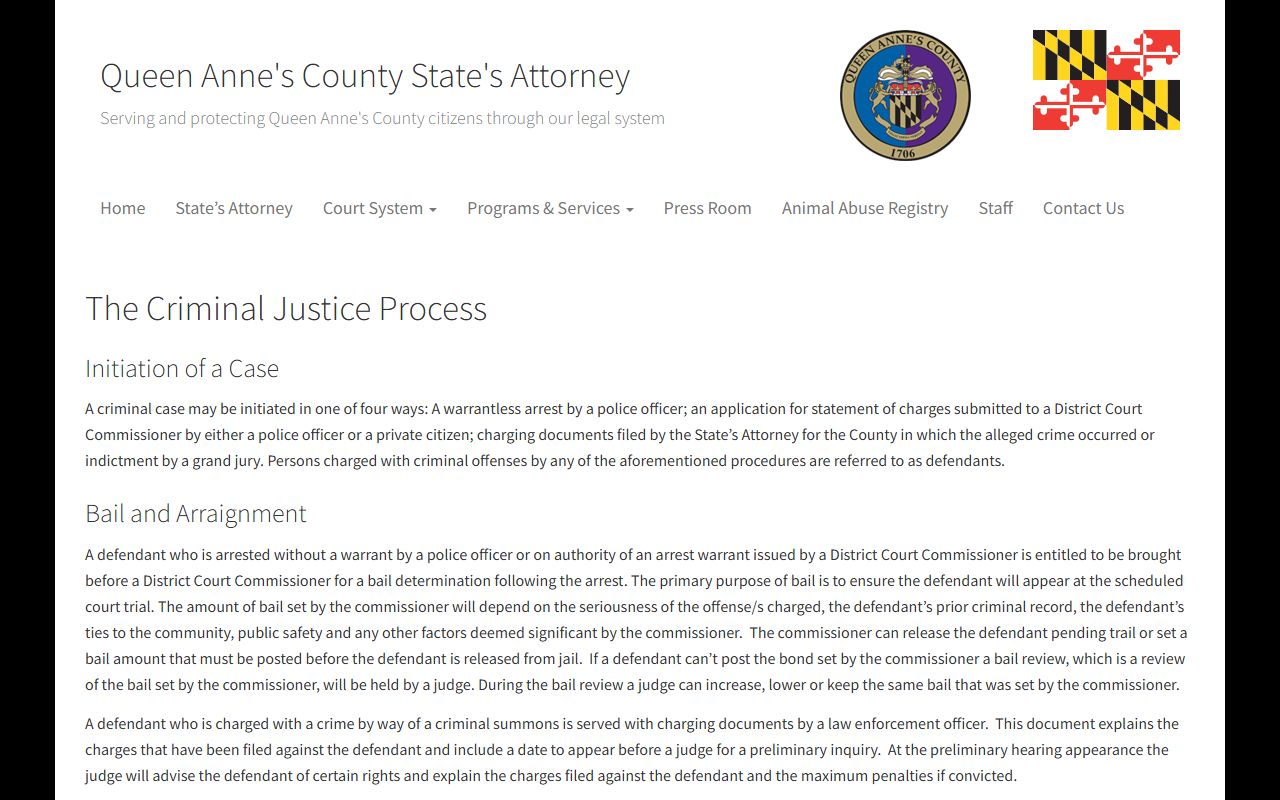
That local prosecutor source is especially useful because it connects the jail arrest to the legal filing step. The arrest may be the event a family notices first, but the prosecutor and the court determine which charges remain active.
From Booking to Commissioner, Bail, Charges, and Case Search
A typical Queen Anne's County path begins when a person is arrested by a local, state, or other authorized law-enforcement agency and taken into local custody unless cited, released, diverted, or moved through a different federal or juvenile route. The detention center records identity and custody details. If the person remains in custody, practical jail questions go to the Queen Anne's County Detention Center at 410-758-3817. If the arrest involved the Sheriff's Office under Sheriff Gary Hofmann, law-enforcement records such as reports or body-camera material may be requested through the sheriff public-information process, not through Case Search.
Maryland's local process then puts the person before a District Court Commissioner or, in some charging paths, before a judge. The commissioner can release the person pending trial or set bail. If bail is set and not posted, a bail review before a judge follows. At bail review, the judge may raise, lower, or leave bail unchanged. A summons case works differently: the person receives charging documents and a date to appear rather than necessarily being booked into jail.
Once charges are filed, Maryland Judiciary Case Search is the public starting point for court records after an arrest. Case Search is a summary system, not a scanned copy of every pleading in the clerk file. It can still show the core case information people need: party names, location, case number, date of birth where available, trial date, charge, and disposition.
The Maryland Judiciary also maintains a local court-record page for Queen Anne's County at courts.state.md.us/clerks/queenannes/courtrecords. That page matters for older Circuit Court records because some local material is available in the clerk's office through Papervision rather than online through Case Search, including criminal dockets from 1945 through November 2000.

Use the court-record page when Case Search does not provide the file depth needed, when an older criminal docket is involved, or when certified copies from the clerk are required.
Case Search Fields for Court Records After an Arrest
Search by case number when it is known. If no case number is available, start with the defendant's name and narrow the result by county, court, date of birth, arrest date, charge wording, or the court date from a bail or charging notice. Maryland's name-search notice says name searches default to exact names. For partial last-name searches, enter at least the first character of the last name followed by a percent sign. A partial first-name search can also use trailing percent, but the percent sign cannot be placed at the beginning or in the middle of a word.
| Field | Type | Required | How It Helps |
|---|---|---|---|
| Case Number | Text | No | Fastest way to open a known criminal or traffic case after the charge has been filed. |
| Last Name | Text | No, unless searching by name | Exact by default. Use the first character plus % for a partial last-name search. |
| First Name | Text | No | Not always required. A trailing % can help with partial first-name searches. |
| Date of Birth | Date or display field | No | Helps separate people with similar names when DOB is shown in the result. |
| Court, County, or Case Type | Filter | Interface-dependent | Use Queen Anne's County and criminal or traffic context when filters are available. |
| Trial Date, Charge, and Disposition | Result fields | No | Used after opening a result to confirm the court date, charge wording, and outcome. |
If the result set is crowded, compare the case to jail-side clues. Booking date, arresting agency, State's Attorney notice, and charge language can help identify the right record. Case Search should not be treated as proof of current custody. A person may have an open case but be released, transferred, held on another matter, or committed to state custody later.
Charging Documents After a Jail Arrest
Formal charges may be narrower, broader, or different from the description someone heard at booking. Police, commissioners, prosecutors, and grand juries perform different functions. The State's Attorney reviews facts and decides how to proceed on prosecutable counts. That review can produce new wording, a different charge level, a dismissal of one count, or an indictment in Circuit Court.
| Charging Document | Who Starts It | Common Use | What to Check |
|---|---|---|---|
| Statement of charges or complaint | Police officer or private-citizen application through a District Court Commissioner | Initial District Court case, summons, or warrant path | Defendant name, case number, charge text, bail or summons date, and court location. |
| Criminal information | State's Attorney | Prosecutor-filed charges in the county where the alleged offense occurred | Whether charges changed from the booking description and whether the case belongs in District Court or Circuit Court. |
| Indictment | Grand jury | More serious felony matters and cases routed into Circuit Court | Indictment counts, arraignment date, bail hearing status, and any related District Court case. |
District Court handles misdemeanors and a limited number of felonies. A defendant who is eligible for jury trial can ask to move a District Court case to Circuit Court when the maximum penalty for one offense exceeds 90 days. Circuit Court handles more serious criminal matters, grand-jury charges, State's Attorney filings within its jurisdiction, appeals from District Court, and jury-trial requests.
Charge Status in Queen Anne's County Court Records
Charge status is the part of court records after a jail arrest that often causes the most confusion. A charge is an accusation until a plea, verdict, dismissal, or other disposition changes its legal meaning. One case can have several counts, and each count can move differently. Read each charge line, not just the case heading.
| Status | Meaning in the Court Record | Practical Note |
|---|---|---|
| Pending | The charge remains active and has not reached final disposition. | Check future hearing dates, bail conditions, and whether the case is in District Court or Circuit Court. |
| Amended or reduced | The prosecutor or court changed the charge wording, count, or level. | Do not rely only on the arrest or booking label. The filed charge controls the court record. |
| Dismissed | The court ended that charge without a conviction on that count. | Other counts in the same case may still be pending or resolved differently. |
| Nolle prosequi | The State declined to prosecute that charge at that time. | This is a prosecutor action and should be read separately from acquittal or conviction. |
| Guilty or conviction | The charge resulted in a guilty plea or finding. | Review sentence, probation, appeal, and post-conviction entries where shown. |
Bond, Bail Review, and Holds After an Arrest
The State's Attorney's local process description explains that a defendant arrested without a warrant or under a commissioner-issued warrant is entitled to be brought before a District Court Commissioner for a bail determination after arrest. Bail is meant to help ensure appearance at the scheduled court trial. The commissioner considers the seriousness of charges, prior criminal record, community ties, public safety, and other significant factors before release or setting a bail amount.
| Release or Hold Type | How It Works |
|---|---|
| Personal recognizance | The defendant is released based on a promise to appear and follow conditions. |
| Cash bond | Money is posted to secure release when a bail amount is set. |
| Surety bond | A bondsman or surety posts the bond under the rules that apply to the case. |
| Bail review | A judge reviews bail if the defendant cannot post the commissioner's bond. |
| No-bond or outside hold | Release may be blocked by a new warrant, violation-of-probation matter, parole or probation detainer, federal hold, U.S. Marshals matter, immigration detainer, or another agency's hold. |
A posted bond does not always mean immediate release. Confirm the current reason for custody with the detention center and compare it to Case Search. The court record may show the criminal case and bail events, while the jail may know about a separate agency hold that is not obvious from the visible case summary.
Warrants and Failure-to-Appear Caveats
Queen Anne's County did not have a general public active-warrant search form in the inspected official sources. The Sheriff's Office publishes a Most Wanted page, but that page is a featured wanted-person list and should not be treated as a comprehensive warrant database. Sample wanted entries can include failure to appear, violation of probation, failure to comply, and similar court-linked matters.
For warrant or wanted-person questions, the Sheriff's Office lists 410-758-0770, with emergencies routed to 911. Sheriff Gary Hofmann's agency also accepts public-information requests for sheriff-held records through its public-information request page. Case Search can help with bench-warrant history, failure-to-appear events, violation-of-probation cases, and hearing dates, but it is still a court-summary tool rather than a sheriff warrant database. If a case number is known, the District Court or Circuit Court clerk can be the better route for court-issued bench-warrant questions.
Charges vs. Convictions in Court Records After an Arrest
An arrest and charge do not equal a conviction. Court records after a jail arrest may show serious accusations at the beginning of a case, then later show dismissal, amendment, nolle prosequi, acquittal, plea, or conviction. Read the disposition line and the status of each count before drawing conclusions.
| Question | Charge | Conviction |
|---|---|---|
| Stage | An accusation filed after arrest, summons, information, or indictment. | A final finding or plea that establishes guilt on a count. |
| Proof level | Based on charging standards such as probable cause and prosecutorial review. | Requires a guilty plea or proof beyond a reasonable doubt at trial. |
| Record effect | May appear publicly while pending or after disposition unless restricted. | May affect sentencing, probation, future charging, and background review. |
| What to verify | Current status, next date, amendments, and whether other counts remain. | Sentence, probation terms, appeal status, and expungement eligibility where applicable. |
Sealed vs. Expunged Court Records After an Arrest
Maryland public-access rules allow inspection of public records unless another law limits access, but criminal justice records can be withheld, redacted, sealed, or expunged depending on the record type and legal outcome. Maryland Public Information Act provisions at General Provisions section 4-201, section 4-202, and section 4-203 set the general request framework. Correctional case records have separate disclosure limits under Maryland Correctional Services section 3-602.
| Issue | Sealed or Restricted | Expunged |
|---|---|---|
| Public visibility | Hidden, limited, or redacted from normal public access. | Removed from public access and treated under expungement rules. |
| Record type | May involve juvenile matters, sealed charges, medical information, investigatory records, or protected court filings. | Can include eligible police and court records after qualifying outcomes. |
| Release without charge | May be restricted while agency rules are applied. | Maryland Criminal Procedure section 10-103.1 covers certain arrests or confinements released without charge on or after October 1, 2007, including police records, photographs, and fingerprints. |
| Where to ask | Ask the court clerk or record custodian tied to the specific record. | Use the proper Maryland expungement process or legal counsel for eligibility questions. |
Clerk Records and the State's Attorney Contact
For full file copies, older dockets, certified records, and local clerk questions, use the Queen Anne's County Circuit Court Clerk's Office. The local clerk record source lists 200 N. Commerce Street, Centreville, MD 21617, phone 410-758-1773, and public office hours of 8:30 a.m. to 4:30 p.m. The clerk is the better source for full court files and Papervision material, while Case Search is the first public summary lookup.
The prosecutor's office is separate from the clerk. Queen Anne's County uses a State's Attorney rather than a district attorney. State's Attorney Lance G. Richardson was appointed in January 2009 and re-elected in 2010, 2014, 2018, and 2022. His office reviews criminal cases, files prosecutor charging documents, handles many prosecution decisions, and runs a diversion program for first-time, misdemeanor, non-violent offenders.
The State's Attorney publishes office and leadership information at qacstatesattorney.com/states-attorney, including Richardson's biography and the office structure.
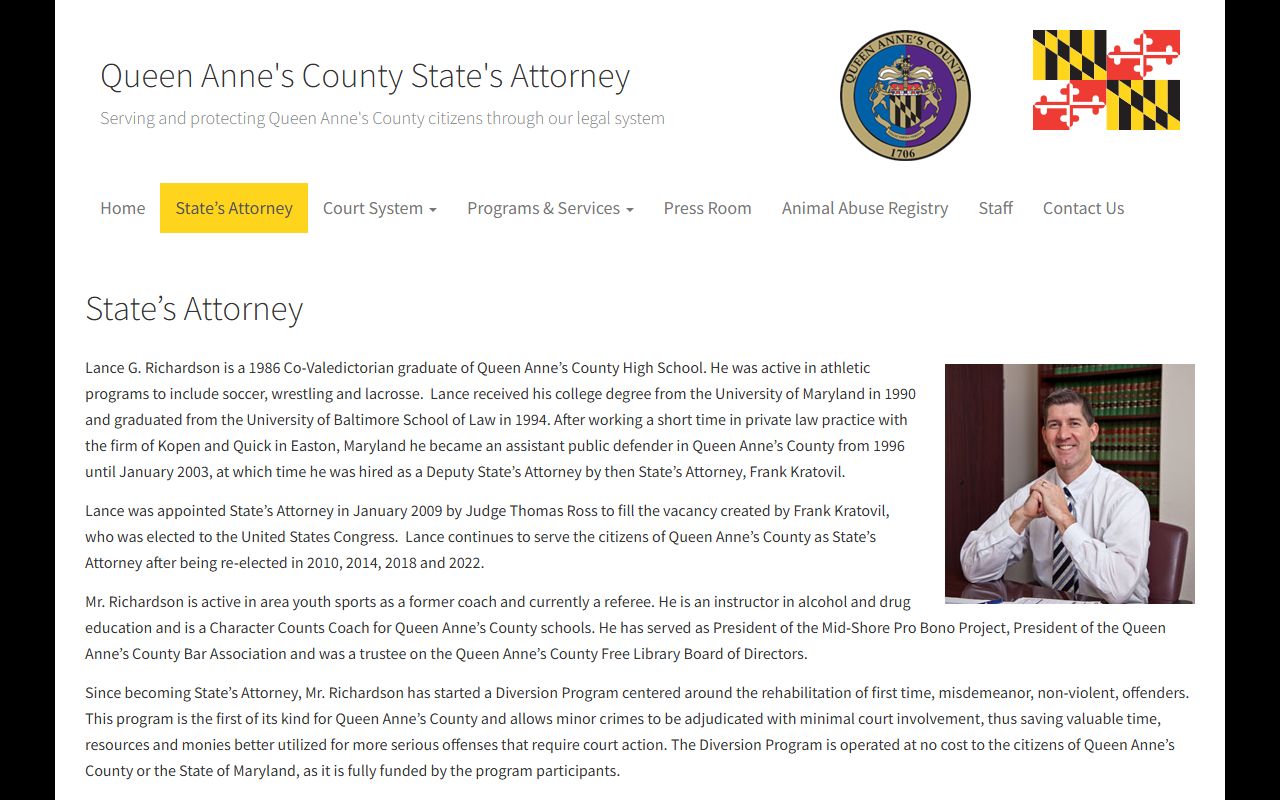
That office context helps explain why charges in court records after a jail arrest can change after booking: prosecutors review the evidence and decide which charges to file, amend, dismiss, divert, or take forward.
Queen Anne's County State's Attorney
107 N. Liberty Street, Lower Level
Centreville, MD 21617
410-758-2264
TTD: 410-758-2126
Fax: 410-758-4409
Monday-Friday, 8:00 a.m.-4:30 p.m.
Queen Anne's County Circuit Court Clerk
200 N. Commerce Street
Centreville, MD 21617
410-758-1773
Monday-Friday, 8:30 a.m.-4:30 p.m.
Use for full court-file copies, older criminal dockets, and clerk record questions.
Background Check Limits for Court Records After an Arrest
Casual court-record lookup is different from a regulated background check. Case Search can show public case summaries, and local offices can provide records when disclosure rules allow it. That does not make every record complete, current, or usable for employment, tenant screening, credit, insurance, licensing, or other regulated decisions. Court summaries may omit restricted material, and the jail may know current custody information that a court summary does not show.
Important: This website is not a consumer reporting agency under the FCRA and is not for employment, credit, insurance, or tenant-screening decisions.
Restricted Queen Anne's County Court Records After an Arrest
Not every record connected to an arrest is public. Juvenile matters, sealed court records, expunged matters, medical and mental-health information, correctional case records, active investigatory records, and protected victim or witness information may be unavailable or redacted. Maryland's Public Information Act gives a general inspection right, but it also leaves room for custodians to deny or limit access when a specific statute, court order, privacy rule, or law-enforcement restriction applies.
When a court summary does not answer the question, identify the exact record needed before contacting an office. Current custody belongs with the detention center. Police reports and sheriff-held records belong with the Sheriff's Office public-information process. Filed criminal charges and dispositions begin with Case Search. Full court files, certified copies, and older Queen Anne's Circuit Court dockets belong with the clerk.